


The Plate Load Test is a fundamental field investigation method used to determine the load-bearing capacity, settlement characteristics, and elastic properties of soils and rock at foundation level. This in-situ testing technique provides direct measurement of how the ground responds to applied loads, offering invaluable data for foundation design, pavement engineering, and ground improvement verification. Our plate load testing services deliver accurate, reliable results that enable engineers to design safe, economical foundations and assess ground conditions with confidence.
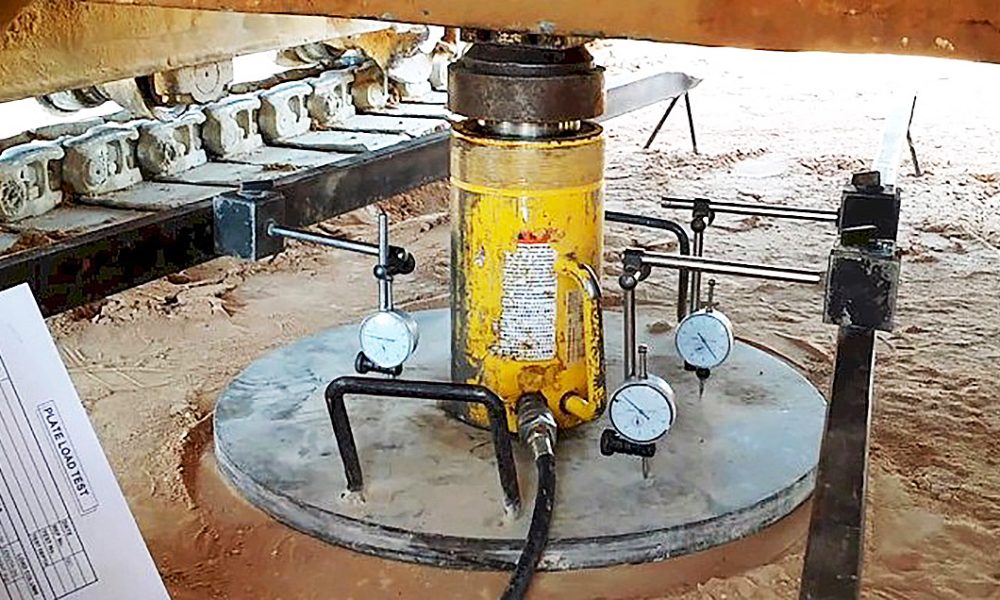
A Plate Load Test involves applying incremental loads to a steel bearing plate placed on the ground surface or at foundation depth and measuring the resulting settlement at each load increment. The test simulates the behavior of an actual foundation under loading conditions, providing direct empirical data about soil bearing capacity, settlement characteristics, and load-deformation relationships. The bearing plate, typically circular with diameters ranging from 300mm to 750mm, is positioned on a carefully prepared test surface. Load is applied using hydraulic jacks reacting against kentledge (dead weight), anchor piles, or ground anchors. Settlement is monitored continuously using precision dial gauges or digital displacement transducers. The test provides site-specific soil behavior data that is often more reliable than estimates based solely on laboratory testing or empirical correlations, particularly for foundations on heterogeneous or disturbed ground conditions.
The fundamental principle of the plate load test is to replicate foundation loading conditions and observe the ground response. Load is applied in increments, typically in five to eight stages up to one and a half to three times the proposed design bearing pressure. Each load increment is maintained until the rate of settlement reduces to a specified value or for a minimum duration, typically one to two hours, ensuring that the soil has reached equilibrium under that load level. Settlement readings are recorded at regular intervals using at least three dial gauges positioned symmetrically around the plate to detect any tilting. After reaching maximum load, the load may be reduced in decrements to measure elastic recovery and determine the permanent settlement component. The resulting load-settlement curve characterizes the soil's response, revealing its elastic behavior, yield point, and ultimate bearing capacity. Additional cycles of loading and unloading may be performed to assess cyclic behavior and soil modulus parameters.
Proper test preparation is critical to obtaining reliable and representative results. The test location is selected based on borehole data, site investigation findings, and proposed foundation locations. Excavation is performed to the intended foundation depth, and the test surface is carefully prepared to ensure it is level, undisturbed, and representative of the bearing stratum. Loose or disturbed material is removed, and the surface may be lightly trimmed or leveled with a thin layer of sand to ensure uniform contact with the bearing plate. The steel bearing plate, machined to precise flatness tolerances, is positioned centrally. The loading system is assembled, which may include hydraulic jacks, load cells, pressure gauges, and reaction systems. Settlement measuring instruments are mounted on independent reference beams positioned well away from the zone of influence to prevent settlement of the reference system from affecting readings. All instrumentation is calibrated and zeroed before commencing the test. Safety measures are implemented to protect personnel during loading operations.
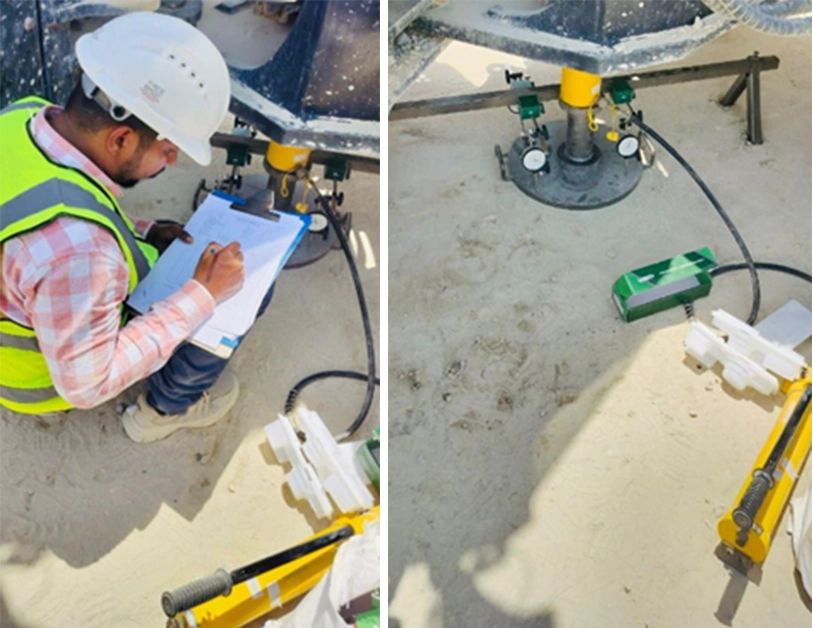
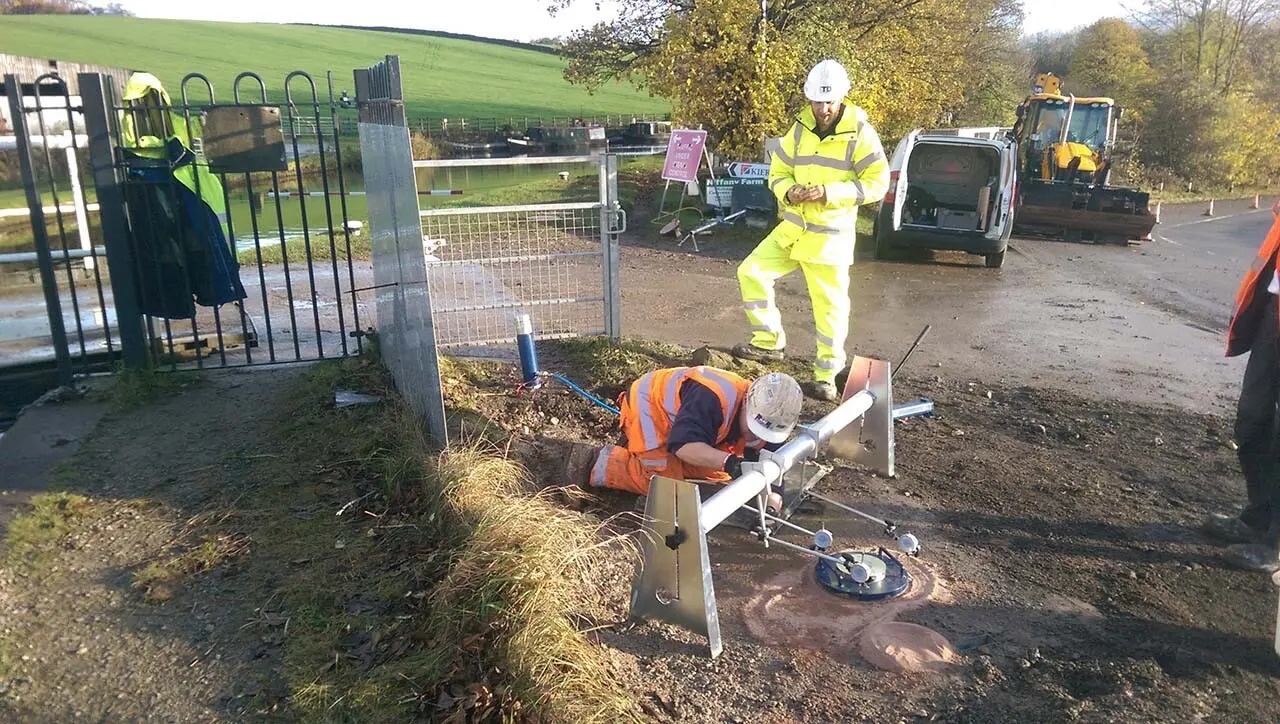
Analysis of plate load test results involves plotting the load-settlement curve and deriving key soil parameters. The ultimate bearing capacity is typically defined as the pressure at which settlement continues to increase without further load increase, or using criteria such as settlement equal to ten percent of plate diameter. The safe bearing capacity is then determined by applying an appropriate factor of safety, commonly 2.5 to 3.0, depending on soil type and project requirements. The coefficient of subgrade reaction, an important parameter for pavement and slab-on-grade design, is calculated from the linear portion of the load-settlement curve. The modulus of subgrade reaction helps predict foundation settlement under working loads. For cohesive soils, the unloading-reloading cycles provide elastic modulus values. The influence depth of the plate load test is typically one and a half to two times the plate diameter, which is significantly less than that of full-scale foundations, requiring appropriate corrections and engineering judgment when extrapolating results to larger foundation sizes.
Plate load testing is conducted in accordance with internationally recognized standards and specifications that ensure consistency, reliability, and comparability of results. Commonly applied standards include ASTM D1194 for bearing capacity testing of soil, ASTM D1195 for repetitive static plate load tests, BS 1377 for British practice, and IS 1888 for Indian practice. These standards specify requirements for plate dimensions, loading procedures, settlement measurement accuracy, test duration, data recording intervals, and reporting formats. The standards also provide guidance on determining bearing capacity, modulus of subgrade reaction, and other derived parameters. Our testing procedures strictly adhere to applicable standards and project-specific requirements, ensuring that results are technically sound, defensible, and acceptable to regulatory authorities and peer reviewers.
Several variations of the plate load test are employed depending on project requirements and site conditions. The static plate load test is the most common, involving gradual application of sustained loads to measure bearing capacity and settlement behavior. The cyclic plate load test applies repeated loading and unloading cycles to assess resilient behavior, permanent deformation accumulation, and dynamic response characteristics relevant for pavement and railway applications. The rapid plate load test uses shorter loading durations and is suitable for quality control during construction, particularly for compacted fills and subgrade verification. Screw plate tests utilize smaller diameter screw plates advanced into the ground at various depths to profile bearing capacity variation with depth. Each test type provides specific information suited to different geotechnical investigation objectives, and the selection of test method depends on foundation type, soil conditions, and design requirements.
Plate load testing offers several significant advantages including direct measurement of in-situ soil behavior under realistic loading conditions, applicability to a wide range of soil types including heterogeneous and disturbed ground, ability to verify ground improvement effectiveness, and provision of empirical data that complements theoretical calculations. However, the technique also has inherent limitations that must be recognized. The limited zone of influence means results represent only a relatively shallow depth and small area, potentially missing deeper weak layers or spatial variability. Scale effects require careful interpretation when extrapolating small plate results to larger foundations. The test is time-consuming and relatively expensive compared to some other field tests. Weather conditions can affect testing, particularly for cohesive soils sensitive to moisture changes. Despite these limitations, when properly planned, executed, and interpreted, plate load tests provide invaluable data for foundation design and construction quality assurance.
Our plate load testing services support diverse geotechnical applications across building construction, infrastructure development, and ground improvement projects. We conduct plate load tests for bearing capacity verification of shallow foundations including footings, rafts, and mat foundations. The tests are widely used in highway and airport pavement design to determine subgrade and base course stiffness parameters. Railway projects utilize plate load testing for track bed bearing capacity assessment. Ground improvement verification through testing on stone columns, dynamic compaction, and soil stabilization treatments confirms treatment effectiveness. Industrial floor slabs and storage tank foundations benefit from plate load characterization of support conditions. Our experienced geotechnical engineers and field technicians conduct tests in accordance with project specifications, analyze results using established procedures, and deliver comprehensive reports with interpreted parameters, load-settlement curves, and design recommendations. We work collaboratively with project teams to ensure that plate load testing provides the reliable foundation design data needed for safe, economical construction.