
Nuclear density gauge testing is a rapid, non-destructive method for determining the in-situ density and moisture content of soils, aggregates, and pavement materials. This technology has become an essential quality control tool in construction projects, enabling real-time assessment of compaction levels and material properties during earthwork, road construction, and pavement laying operations. Our nuclear density testing services provide accurate, reliable measurements that ensure construction materials meet specified compaction requirements, supporting safe and durable infrastructure development.
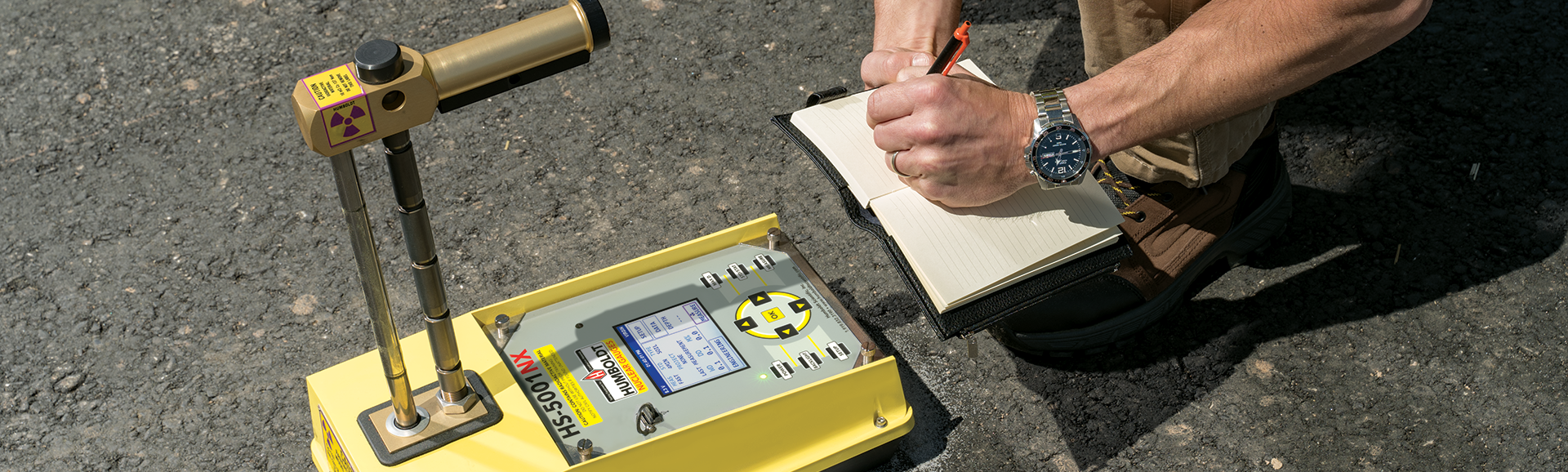
Nuclear density gauge testing utilizes radioactive isotopes to measure the density and moisture content of construction materials in the field. The device contains a sealed radioactive source that emits gamma rays and neutrons into the material being tested. The density is determined by measuring the scattering and absorption of gamma radiation, while moisture content is assessed through the thermalization of fast neutrons by hydrogen atoms present in water. The gauge provides results within minutes, allowing immediate verification of compaction quality and enabling contractors to make real-time adjustments to compaction procedures. This rapid feedback mechanism significantly improves construction efficiency and quality assurance compared to traditional laboratory-based density testing methods that require sample extraction and time-consuming processing.
The nuclear density gauge operates on well-established physical principles. For density measurement, a cesium-137 or americium-241 source emits gamma rays that interact with electrons in the soil or pavement material. The amount of backscatter or transmission detected is inversely proportional to the material density. For moisture measurement, an americium-241:beryllium source produces fast neutrons that are slowed down through collisions with hydrogen nuclei, which are primarily present in water molecules. The thermalized neutrons are counted by a detector, with higher moisture content producing more thermalized neutrons. Modern nuclear gauges incorporate microprocessors that automatically convert radiation counts to density and moisture values, applying calibration factors and corrections for temperature, material composition, and measurement geometry. The gauges can operate in backscatter mode for shallow depth measurements or direct transmission mode for deeper profiling, typically measuring densities from 50mm to 300mm depths.
Proper field testing procedures are essential for obtaining accurate and representative nuclear density gauge measurements. Prior to testing, the surface is prepared by removing loose material and creating a smooth, level seat for the gauge. A small hole may be drilled to accommodate the probe in direct transmission mode, ensuring good contact between the source rod and surrounding material. The gauge is positioned carefully and standard count measurements are performed, typically lasting one to four minutes depending on the required precision. Multiple tests are conducted across the compaction area following a systematic pattern to ensure representative sampling. Test locations are selected to avoid areas near edges, joints, utilities, or other anomalies that could affect readings. Results are compared against project specifications, which typically require achieving a specified percentage of maximum dry density determined from laboratory Proctor compaction tests, commonly 95% to 100% depending on the application and material type.
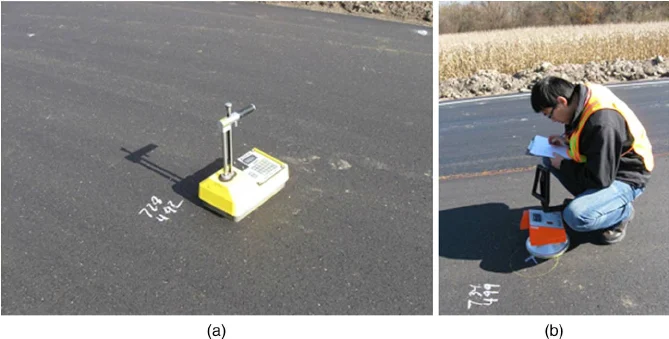

Nuclear density gauge testing is the primary tool for compaction control during earthwork and pavement construction. Proper compaction is critical to achieving adequate load-bearing capacity, minimizing settlement, preventing differential movement, and ensuring long-term structural performance. During construction, nuclear density tests are performed on each compacted lift to verify that the specified relative compaction has been achieved. If test results indicate insufficient compaction, additional rolling is performed and the area is retested until acceptance criteria are met. The real-time nature of nuclear testing allows immediate corrective action, preventing the placement of subsequent lifts over inadequately compacted material and avoiding costly rework. Testing frequency is specified in project specifications or quality assurance plans, typically ranging from one test per specified area or volume of placed material, with additional tests in areas of concern or where initial results are marginal.
Accurate nuclear density gauge measurements depend on proper calibration and regular quality control checks. Each gauge must be calibrated for the specific materials being tested, as different soil types, aggregates, and asphalt mixes have varying chemical compositions that affect radiation interaction. Calibration involves correlating gauge readings with known densities of standard materials or comparing gauge results with laboratory-determined densities of field samples. Daily standard counts are performed using reference blocks to verify that the gauge is functioning correctly and producing consistent results. Manufacturers' calibration is verified periodically through comparison testing with sand cone, water replacement, or core sample methods. All gauges undergo regular leak testing to ensure the integrity of the sealed radioactive source. Complete documentation of calibration records, standard counts, and quality control checks is maintained as part of the project quality assurance program.
Nuclear density gauges contain sealed radioactive sources and must be handled, transported, stored, and used in strict compliance with radiation safety regulations. All personnel operating nuclear gauges must complete radiation safety training, pass competency examinations, and hold valid licenses or certifications issued by relevant regulatory authorities. Our technicians are fully licensed and trained in radiation safety, gauge operation, emergency procedures, and regulatory compliance. Gauges are transported in approved shipping containers and stored in secure locations when not in use. Radiation monitoring badges are worn to track exposure levels, and handling procedures minimize exposure through distance, shielding, and time controls. Regular wipe tests confirm the integrity of source encapsulation. Emergency response procedures are established for loss, theft, or damage scenarios. All operations comply with national radiation protection standards and transportation regulations for radioactive materials.
Nuclear density gauge testing offers numerous advantages including rapid results, non-destructive measurement, ability to test in place without sample disturbance, measurement of both density and moisture simultaneously, and testing at various depths. These benefits make nuclear testing highly efficient for large-scale construction quality control where timely results are essential. However, the technology has limitations that users must understand. Readings can be affected by surface irregularities, material heterogeneity, thin lifts, proximity to edges or voids, and chemical composition variations. Nuclear gauges measure a relatively small volume of material, requiring multiple tests for representative coverage. Regulatory requirements for licensing, training, and handling add administrative complexity. In recent years, alternative technologies such as electromagnetic density gauges and soil stiffness gauges have emerged that avoid radioactive sources while providing comparable results for many applications.
Our nuclear density gauge testing services support quality control across a wide range of construction projects including highway and road construction, airport runway and taxiway development, earthwork and grading for building foundations, dam and embankment construction, railway track bed preparation, parking lot and industrial pavement installation, and backfill compaction for utilities and retaining structures. We provide experienced, licensed technicians equipped with calibrated nuclear density gauges who conduct systematic testing programs in accordance with project specifications and quality assurance plans. Test results are documented with location coordinates, test parameters, measured values, specification compliance status, and photographic records. Data is compiled in comprehensive reports that support contractor payment verification, quality assurance documentation, and regulatory compliance requirements. Our services help ensure that construction projects achieve specified compaction standards, supporting safe, durable, and cost-effective infrastructure development.